Showing posts with label mobility. Show all posts

Saturday, October 25, 2008

London's Black Cabs May Go Electric


According to our friends at ETA, the iconic London black cab may soon go electric.

Chinese car maker Geely, which owns a large stake of taxi-manufacturer LTI vehicles, is currently developing its own plug-in hybrid and electric cars and is examining the feasibility of converting the diesel-engined cabs to run on battery power.

Apparently, a London TX4 taxi emits a whopping 226g CO2 per km, which is more than twice the amount produced by today’s most efficient diesel cars. As there are 20,000 black cabs in London, that makes a strong case for converting to electric power.

Monday, September 22, 2008

Baby Dies as 4x4 Mounts Pavement

In a startling (yet unfortunately not uncommon) news story this week, a toddler in a pushchair was killed by a yummy mummy driving a 4x4 on the school run when she mounted the curb outside the school gates.

According to the article, "Fifteen-month-old Finlay Woods was out with his mother and grandmother when the black Toyota 4x4 crashed into his buggy, outside Selwyn junior and infant school in Chingford, north-east London, while parents gathered their children from school."

Parents tried in vain to lift the vehicle off the child, while others shielded school pupils from the distressing scene.

Witness Lee Rivers said: "I was one of about 15 people who tried to lift the car up to get the pushchair out from under it. But it was too heavy because it was a big 4x4."

Flowers were laid outside the school yesterday next to a smashed pillar and railings mangled in the crash. The mother was charged with causing death by dangerous driving, and driving while under the influence of drink or drugs.

Friday, September 05, 2008

Jaguar and Land Rover Sales Down as Buyers Seek Efficient Cars

This news comes from ETA:

Fewer cars were sold in the month of August than at any time since 1966. The drop in sales has been especially hard on British-made luxury brands such as Aston Martin, Jaguar and Land Rover.

This time of year has traditionally been a strong time for new car sales because new registration plates were issued, but despite the fact the plates are now released in March and September and there is no longer a guaranteed peak in August, this year’s figures are particularly bad; overall sales are down 18.7 per cent on 2007.

Toyota and Land Rover have announced production cutbacks because of falls in orders and Britain’s automotive industry, which employs 815,000, is urging the government to drop interest rates to stimulate the market.

A spokesperson for the Environmental transport Association (ETA) said: “In the current economic conditions it’s quite understandable that people are unwilling to buy new cars, but it is the heavier, thirstier cars that are suffering particularly badly – smaller, greener, more frugal models are continuing to sell.”

The revised rates of emissions-based vehicle excise duty (road tax) has further harmed sales of larger, fuel inefficient cars.

To find the greenest cars, try the ETA's Car Buyers Guide

Friday, August 29, 2008

Public Says Car Makers Must Go Green

The results of an opinion poll out today show an overwhelming 87 per cent of people in the UK think measures to force car manufacturers to make smarter cars that use 25 per cent less fuel should be introduced urgently.

Two-thirds of respondents thought that requiring car manufacturers to reduce the fuel consumption of their vehicles by a quarter would boost the UK economy - because people would spend less money on fuel and so have more to spend on other things.

And the poll shows there is a clear public appetite for green motoring - over half of those questioned saying that apart from cost, fuel consumption was the most important factor in choosing a new or second hand car - ahead of safety and comfort.

The TNS poll, commissioned by Friends of the Earth Europe questioned a total of 4885 people in the UK, Germany, Spain, France and Italy. The results come days before key MEP votes in the European Parliament which will be critical in determining future emissions standards for new cars.

Reducing the fuel consumption of cars sold in the EU by 25 per cent would cut average carbon dioxide emissions from new cars to approximately 120g CO2/km, the 2012 target that we have been pushing for at the Alliance.

These survey results mirror what people have told us on the streets: they are horrified by how much they have to spend on petrol and agree that they would be willing to pay more for a more fuel efficient car.

Consumers urgently need our MEPs and UK ministers to have some guts and push for stringent carbon dioxide targets.

The polling included male and females from all age groups and a range of backgrounds. 984 people were questioned in the UK. The results showed that:

66 per cent of UK respondents thought that requiring car manufacturers to reduce the fuel consumption of their vehicles by a quarter would boost the UK economy - because people would spend less money on fuel and so have more to spend on other things.
58 per cent of UK respondents said that apart from cost, fuel consumption was the most important factor in choosing a new or second hand car - ahead of safety (34 per cent) and comfort (18 per cent).

According to Friends of the Earth's Senior Transport Campaigner Tony Bosworth, "The message has come across loud and clear: people want car makers to produce cleaner, smarter cars that use less fuel, reduce climate change emissions and slash fuel bills.

"Politicians must act on public demand by standing up to the self-interested lobbying of the car industry and delivering the tough standards that people clearly want".

MEPs need to hear from the public right nw, as there are 2 crucial votes in the EU in the next 2 weeks. Go to our new action website www.forlesspollutingcars.com and send an email to the crucial UK MEPs.

Monday, August 25, 2008

Car Makers Cancelling New 4x4 Models

In the wake of the economic downturn, consumer demand for new cars is falling. As a consequence, car makers across the USA and Europe are canceling or postponing plans to introduce new car models, including 4x4s.

According to Automotive News Europe, Renault, Opel and BMW are among car companies stopping or delaying planned new models due to difficult economic conditions. Most notably, BMW has axed its planned X7 premium 4x4. The model was to be aimed at rivals such as the Land Rover Range Rover.

Besides saving on product development, some European carmakers are also cutting production and revising down their unit sales and profit forecasts for 2008.

Here is a summary of new models being axed or delayed:
* Renault Espace, Megane crossover, Vel Satis replacements
* Opel/Vauxhall flagship, small SUV
* BMW X7
* Volvo C30 variants

Sunday, August 03, 2008

Swiss Young Greens to Ban 4x4s from Switzerland

Today we received welcome news from our friends in the Swiss Young Greens, who are gaining support for a federal popular initiative to ban large heavy and polluting luxury 4x4s from the Swiss market.

In Swiss law, Swiss citizens can freely form an association and propose a modification to the Swiss Federal Constitution. The association collects signatures of Swiss citizens who support the proposal. If the Initiative collects 100,000 valid signatures the proposal is voted by the whole population of Switzerland. If accepted by the People, the Government must enforce the legislative change.

According to Vincent Rossi, about 150,000 signatures have been collected so far. The vote could occur in 2010.

With this large success, the Young Greens have surprised the Swiss political scene and reactivate the debate on consumers' 'freedom to pollute'.

Technically, the Initiative requires all vehicles that are too dangerous or too polluting to be banned from sale in Switzerland. Existing vehicles can still be used, but with limited speed. "Too dangerous" means too heavy or with a too high a front end. "Too much polluting" means emitting too much CO2 or fine particles. Swiss and international studies demonstrate the relevance of these criteria.

The Young Greens have set thresholds for private cars in order to especially target SUVs and powerful roadsters: 250 gCO2/km and 2.5 mg PM10/km. Half of the SUVs sold in Switzerland would be hit, while only 6% of the family cars would. A 'light or ecological' car emits about 100 gCO2/km. A large SUV can reach 400 gCO2/km.

Sunday, July 20, 2008

Mundo Launch a Success

Last Friday we launched Mundo Cars in the UK. The Alliance is encouraging MEPs and MPs to get involved.

Jean Lambert MEP came and gave a great speech, and even helped us push for new fuel efficient cars.

According to Jean, "Londoners are forced to live with poor air quality on a daily basis and suffer the health effects of road transport pollution. Enough is enough. There is no place for highly polluting cars in London where air quality consistently fails basic EU standards."

"I encourage citizens and politicians to support this campaign for stricter fuel efficiency standards. The car industry should be making use of the full range of technology to make cleaner cars and the Government must support this change by introducing tough targets and penalties for those unwilling to reform."

The car industry is actively blocking meaningful regulations that would make vehicles significantly less costly to run, and that is hurting everyone while oil prices soar. The recent King Review pointed to the fact that although the technology is now available to produce more fuel efficient cars, manufacturers are by and large not doing so.

With fuel prices ever escalating, there is both an economic and an environmental necessity for cleaner cars. For our launch film we interviewed people who were filling their tanks up at fuel stations. They were horrified about how much they have to spend on petrol and all agreed that they would be willing to pay more for a more fuel-efficient car if they would then pay less for fuel. The public are ready for the cars of the future – now the EU and UK Governments must push for stringent CO2 targets.

We are encouraging car manufacturers to think big and be bold – and only when the EU and the UK Government push for stringent fuel efficiency targets will this happen in a creative and radical way.

Mundo Cars is already attracting political support from other MEPs.

Green MEP Caroline Lucas said: “The point is it’s not rocket science. Some cars have the ability to meet the 120g/km standard now so the technology does exist. That’s why the Mundo Cars campaign is so important. It demonstrates what the car of the future could be like. I think it’s an inspiring idea and an inspiring campaign. I urge people to get involved and be part of the solution.”

Robert Evans Labour MEP said, “The time for action on climate change is now. We cannot wait any longer for the effects to be seen across the world and so I urge everyone, public and politicians alike, to support strong targets on C02 emissions from cars. We must do more to discourage the highest carbon producing cars so that we can all tackle climate change before it is too late. Experts suggest the changes might be irreversible in just seven years time."

According to Fiona Hall, Lib Dem MEP, “some 19% of all Europe’s carbon emissions come from passenger cars and light-commercial vehicles. Absolute volumes are increasing because there are more cars being put on the road. The vehicles are heavier (up 15% in the past decade) and more powerful (up 28%) even though speed limits have not risen anywhere in Europe. We now need to set mandatory requirements to make a difference. I recently argued that the Commission's proposals did not go far enough and that the regulation should push for average fleet emissions of 120 g/km by 2012 achieved by vehicle improvements alone. Such targets would only be achievable with consequent penalties, which would put pressure on the manufacturers.”

Claude Moraes MEP said “We [Labour MEPs] believe that the car industry has had a long time to clean up its act and while progress has been made it has not been sufficient. Time has come for strict mandatory targets to be put in place as soon as possible.”

The automobile designers are the captains of the ship, not the consumers as they so often suggest. The industry signals the intention and the direction for the car market by their designs. To date they have been designing highly polluting and consuming vehicles. But times are rapidly changing, and we need a whole new evolution in the approach to making and powering a car, and that needs a heroic effort.

Help Mundo push for fuel efficient cars. Join the campaign.

Wednesday, July 09, 2008

Get Lost Porsche - Make Room for the New Sports Cars


Move over Porsche.

The futuristic sports cars for the 21st Century are being developed by Tesla, RiverSimple, and now, the Lightning Motor Company.

According to reports, "the Electric Lightning GT appears to have everything an ecoconscious lover of British sports cars could want: a luxury interior, a top speed of 130mph and acceleration that would put a Porsche to shame." The Lightning GT will accelerate from 0-60mph in four seconds and will be able to travel up to 200 miles on a single battery charge.

They replaced the fuel tank, engine and transmission system found in standard vehicles with an electric motor inside each wheel. There is no gear stick, axle or drive shaft. "All of the power is generated at the wheel, the point at which it's required, which eliminates mechanical complexity and power losses experienced in standard sports cars," the company says.

The new prototype car will be unveiled at the British Motor Show in July.

Monday, June 23, 2008

Is the Car Industry Headed in the Right Direction?

I came across an interesting article by Iain Carson in the Guardian. He argues that "manufacturers will only deliver improvements when they are forced to."

Giving us a brief history lesson, he cites that "One hundred years ago this October Henry Ford's Model T launched the mass motor industry. Simple and rugged enough for country tracks, it was also the world's first flex-fuel vehicle. Its engine could runon petrol or ethanol; Ford thought that farmers might prefer to make their own fuel from corn. In fact it was already as economical with either fuel as the average American car today."

"Until the Model T, nine out of 10 cars were electric. Gasoline-powered vehicles came to dominate as oil was found in Texas, and the battery-powered starter motor made internal combustion cars easier and safer to start, without dangerous backfires. Now the car industry looks set for another revolution."

"The most hopeful sign across the board is that the car industry, led by Toyota, has realised that it is in its own interest to develop alternative technologies that really work to cut carbon emissions. Toyota has sold a million of its conventional petrol-electric hybrid cars, and other manufacturers are piling in with their versions. GM [recently] reaffirmed bringing to market its Volt plug-in hybrid in 2010 - and said it might ditch its gas-guzzling Hummers."

"The Volt is an example of the latest twist in the hybrid - it can be plugged into the mains overnight, and equipped with a battery that can provide a range greater than 30 miles; the petrol engine is only a stand-by if the battery runs down. Battery-powered vehicles, even if the electricity comes from coal-fired power stations, are more energy efficient than internal combustion engines; if the electricity comes from nuclear or renewables, there is no carbon emission at all."

"Beyond the plug-in hybrid or battery-only car being developed by Renault and others, there is the fuel-cell electric vehicle, running on hydrogen and emitting only water vapour from its exhaust pipe. Makers such as Toyota, Honda and Mercedes believe that the car of the future will be powered by hydrogen fuel cells within 20 years, and costs are coming down as parts suppliers develop mass production techniques."

"Oil and energy companies are working with Mercedes and others to create a "hydrogen highway" carving through Germany from north to south. The European commission and the German government are putting about a billion euros into developing the network. Even if making hydrogen consumes electricity, the fuel cell is still more efficient than internal combustion engines."

"No one can be sure if electric cars, biofuels or hydrogen power are the answer to cutting emissions. What seems to be happening is that these different technologies are competing with each other to improve the carbon footprint of road transport. The tougher the rules, the harder car companies will work to find alternatives. And high petrol prices are already changing US motorists: in March they drove about 10% less than a year earlier, and sales of gas-guzzling SUVs have tumbled. Meanwhile, even if oil eases back to around $100 a barrel, the days of cheap motoring are over."

Thursday, June 19, 2008

Alliance Wins Legal Challenge: Car Billboard Ads to Show Climate Impact

Car adverts on billboards and in magazines will now be emblazoned with the car’s climate impacts, after the Government yesterday agreed to change its advertising guidelines in response to the threat of legal proceedings by the Alliance Against Urban 4x4s.

The fuel consumption and CO2 emissions of vehicle will now have to be prominently displayed, arming consumers with the information they need to choose a greener vehicle – and one that needs to be filled up with fuel less often.

The Department for Transport admitted that it had been wrongly interpreting an EU Directive on car advertising, which says that fuel economy and carbon dioxide emissions information must be prominently provided in all promotional literature. The Government has until now exempted ‘primarily graphical’ adverts from the law with the effect that most billboard adverts did not include information about the car’s carbon dioxide emissions.

The announcement came in response to a legal letter to the Department for Transport from Friends of the Earth’s Rights & Justice Centre acting for the Alliance Against Urban 4x4s. We wrote to the DfT in March to point out that the UK wasn’t abiding with EU law and warned the Government that they would issue Judicial Review proceedings if the guidance was not changed.

From now on, it won’t be enough to woo consumers with a sleek and sexy image of a car in billboard ads – car advertisers will need to give real and readable facts about the car’s fuel economy and environmental impact. With rising fuel costs and a growing awareness about climate change, this information is crucially important for people to make greener and cheaper choices of vehicle.

In order to cut emissions from cars, we need both strong regulation on advertising and also strong regulation that forces car manufacturers to make more efficient cars. Today’s change in the advertising rules will help encourage car-makers to build more efficient vehicles, something they have so far been very slow to do.

Phil Michaels, Head of Legal at Friends of the Earth said:
“Until now allowed the UK was getting away with flouting EU legislation on car advertising – but our legal action has closed the loophole.

“Consumers have a right to meaningful information about how much carbon dioxide a car emits and how much fuel it guzzles, so they can choose to buy a car that will be greener and cheaper to run. We will be watching carefully to make sure that the law is now properly enforced.”

See the cars and CO2 campaign website here: http://www.advertiseCO2.co.uk

Sunday, June 08, 2008

New Health Warnings on Car Ads


Lib Dem MEP Chris Davies and the EU Environmental Committee have started a move that may see 20% of all car ads covered with health warnings similar to the one pictured.

According to Mr. Davies, "I want to encourage a shift in consumer behaviour which will communicate to car manufacturers in a financial way that it's in their interests to reduce emissions. Manufacturers of high emission cars hate this idea."

Londoners can attest to the anger of car manufacturers when they hate an idea; Porsche recently ran an all out PR battle to have Ken Livingstone defeated when he threatened to charge their beloved gas guzzlers up to £25 per day.

Promotional material including magazines, newspapers and billboards posters for new cars must currently include CO2 and fuel consumption information, although many car manufacturers fail to comply. The European Commission is now being urged not only to enforce the existing regulations but also to extend the rules to cover television, radio and internet.

Thursday, May 15, 2008

Our Friend Miranda

We don't always want to talk about boring politics and what manufacturers and the government isn't doing - so we thought we'd mention our friend Miranda, over at the Accidental EcoManiac

Introducing her blog she writes: "I never wanted to become an EcoManiac. I was busy living the good life, complete with retail therapy and long-haul flights. In fact, when I moved back to London in 1999, I thought our home would be just perfect if we added a patio heater and outdoor hot tub. Who knew I was an accomplice in the murder of the planet?"

She writes lots of great articles and provides links to new 'green' stuff, including 'hot wheels'.

Miranda's written us this Top Hole entry all about 4x4s: "The 4x4 phenomenon (in the US and now in the UK and worldwide) is a triumph of advertising and cultural persuasion over common sense. For a while, MPG was the buzzword and it seemed cars were getting smaller and more efficient (and cheaper). Of course that’s not great news for car manufacturers – or the oil companies – so they started supersizing cars (and their advertising budgets)."


"I remember the first time I heard someone describe a 4x4 as 'sexy' (maybe 1981, soon after Reagan was elected, but when the ‘oil crisis’ of the 70s was still fresh in the mind.) I was shocked - at that time small sport scars were the height of cool (and midlife crises). I suppose 4x4s hint of a sporty, outdoorsy lifestyle (though instead of surfboards or camping gear, most 4x4s carry nothing more thrilling than the weekly shop)."


"Throughout the 90s and 00s, cars plumped up. At first they looked a bit OTT, but as the years passed and more people bought them, the behemoths didn’t look quite so odd. And celebrities' star power rubbed off and helped make 4x4s 'cool'. The ‘safety’ argument helped salve any misgivings and made people feel proud of their choice – and happy to defend it. Of course 4x4 are not so great for other road users or us pedestrians, but hey, there aren’t that many pedestrians in America anyway."


"Big cars got another boost when the IRS tax system (US) had a loophole for some SUVs allowing a deduction of up to $25,000 for for vehicles between 6-14,000 pounds. Buy a bigger car and get a 'rebate'? Who could resist that? Not many: most people in the US - even teenagers - drive gigantic cars. But now many families are finding it too expensive to fill up their 'gas guzzler' in order to travel to work, school or the shops, and the 4x4 craze doesn't seem quite so clever."


"Unfortunately the UK public has also indulged in bigger and heavier cars. The advertising seems irresistible. A 4x4 glides through the Nevada desert on an empty highway. Another climbs a cliff - what a thrilling adventure! What if ads had to show the grim reality – a frustrated UK driver trying to manoeuvre a 4x4 on a narrow road in an English village (or even in London), or trying to squeeze its giant girth into a standard car park space."


"I just can’t see why many people need a car like this (especially not in London). If your self-esteem needs a boost, do some volunteering or try to become a better person. Driving a big car doesn’t make you a big man (or woman)."


Cheers, Miranda

Monday, April 21, 2008

Richmond: School Run Charges for Hi-CO2 Cars

In another ground breaking move by Richmond Council, cars on the school run are to pay for temporary council parking permits which will vary in price according to the CO2 emissions level of the car. The pilot is scheduled to start in September.

According to the Telegraph article, 'Parents are to be charged up to £75 a year by councils to drop their children off on the school run.'

'Richmond introduced "environmentally friendly" parking charges based on vehicle emissions in late 2006 and now the Liberal Democrat authority has gone further by introducing its "permits for school parents", affecting hundreds of people across 13 schools in the borough.

'Previously, parents could collect a free permit from the school, allowing them to park on yellow lines or in nearby bays for 10 minutes. From September, they will have to get a council permit to park in bays near the school for 15 minutes.'

'The fee will vary according to the car's carbon dioxide emissions, with owners of small cars paying nothing, while most parents with people carriers or four-wheel-drives, pay the full £75.'


Friday, March 21, 2008

Big Polluters Like Porsche or Rolls-Royce Have to Change

Today Europe's environment chief Stavros Dimas said that he personally sympathised with a plea made on the BBC recently by the former Shell boss Sir Mark Moody-Stuart.

In a Green Room article he urged the EU to set minimum standards for car efficiency in the same way they set minimum standards for fridges. He suggested totally banning cars that manage less than 35 mpg.

That would mean big polluters like Porsche or Rolls-Royce would have to radically change the way they make their cars or be banned from sale.

Mr Dimas said there was a clear ethical case for this argument - but that Europe had to protect its own industries too - and would stick by the current policy of asking manufacturers to produce 130g of CO2/km across the fleet.

Backtracking under pressure by the automotive lobby, Angela Merkel, the German Chancellor, has done a complete climate change U-turn. According to the Times, “I will be standing up particularly for jobs in Germany’s car sector,” she said, under pressure from manufacturers such as Mercedes, Audi and Porsche which face big fines if they do not reduce exhaust emissions substantially.

According to Mr Moody-Stuart: " Without regulation to channel their power, markets will not deliver things which are of no immediate benefit to the individual making his or her choice, even though they may be beneficial to society."

This really is becoming a war between protecting the old economic industries and moving on to protect the planet. But can governments really afford to dig their heels in the ground?

Monday, March 17, 2008

new Video: Do You Really Need a 4x4?

Mayor and TfL Prepared to Fight Porsche in Courts

Mayor of London, Ken Livingstone and Transport for London (TfL) rejected a demand by luxury and sports car manufacturer Porsche to scrap plans for a higher £25 Congestion Charge for the very highest CO2 emitting cars, including many of the so-called Chelsea Tractors, the most powerful sports cars and some luxury executive cars, as part of the capital's plans to tackle climate change and cut congestion.

Ken Livingstone said: "Porsche have a clear vested interest in attempting to block this ground breaking scheme, against the interests of Londoners as a whole. They should focus their attentions on cutting CO2 emissions from the cars they produce, rather than pursuing this pointless legal action which we will vigorously contest. We have already seen several motor manufacturers rise to the challenge of cutting CO2 emissions from their cars and Porsche should join them.

Michèle Dix, Managing Director of Planning, TfL, said: "The Congestion Charge scheme has been a success at cutting congestion and traffic, with around 70,000 less vehicles a day entering the original central zone. Without it congestion in central London would be far worse.

"The principal aim of the scheme remains tackling congestion. The aim of the CO2 Charge element and discount of the scheme is to cut CO2 emissions by reducing the number of very high emitting cars driving in central London, influencing people's car purchasing choices and by stimulating the market for low emissions cars.

"At the moment, 17 per cent of cars driving in the charge zone are in Band G, while just 2 per cent are in Band's A and B. We expect to see the number of Band G cars cut significantly over time."

Specifically setting out to Porsche why their objections are unfounded, the Mayor and TfL made clear that:

· The CO2 Charge is about reducing CO2 emissions from cars driving in central London, whilst reducing congestion, as part of the Mayor's Transport Strategy and Climate Change Action Plan; and

· It is quite clear motorists have the choice not to drive a high CO2 emitting, car in central London, given the wide range of lower emitting cars available. Along with the higher £25 Charge for the cars emitting the most CO2, there will be a 100% discount for the least emitting.

Monday, February 18, 2008

We're Not Anti-Car, But...

I'd like to set the record straight. We're not anti-car.

Unlike some of our green colleagues who want only to rid the city of cars altogether, we've always understood that some may need a car. What we do find more interesting is redirecting the current trajectory of personal mobility away from large gas-guzzling, clumsy and poorly designed vehicles to something new, graceful and a harmonius part of our environment.

The 4x4 (4-wheel drive) was originally designed to be a service vehicle for wartime - an all-terrain vehicle. Unfortunately, that capability isn't required in the city, yet due to their glorification and slick psychological manipulation by the advertising agencies, these clumsy cars have achieved star status. That's what we are actively undermining.

This is the cold reality of our times: with the urgency of climate change intersecting our pathway of self-centered economic advancement, our increasingly congested environment is screaming for new solutions.

Filling our land with increasingly larger, more powerful belching vehicles isn't the future we're prepared to accept.

Unfortunately for our detractors, we've already won. The minute that 4x4s started to be debated openly in public, our campaign won because it reached the 85% who also see they are not the future.

Monday, February 04, 2008

EU Should Ban Inefficient Cars


Ahhh. It's music to our ears. The sweet sound of common sense from a businessman. Finally.

Today, BBC news reported the ex-Chairman of Shell felt the EU really ought to ban inefficient cars (cars that get below 35 miles per gallon), and he believes industry will follow stricter environmental guidelines.

"Nobody needs a car that does 10-15 mpg (miles per gallon, 19-28 litres per 100 kilometres)," Mark Moody-Stuart was quoted as saying.

According to Sir Mark Moody-Stuart, "We need very tough regulation saying that you can't drive or build something less than a certain standard. You would be allowed to drive an Aston Martin - but only if it did 50-60mpg."

He continues, "When we eliminated coal fires in London we didn't say to people in Chelsea you can pay a bit more and toast your crumpets in front of an open fire - we said nobody, but nobody, could have an open fire.

"When we introduced catalytic converters the car-makers said it would put the price of cars through the roof - but it didn't. Now we all have to have catalytic converters - that's only right."

"Government's job is to set the framework in which industry can compete," he added. "The market is a magical thing - it will meet people's convenience but it needs guiding."

He said the EU was far too lax with motor manufacturers.

Sir Mark sums it up in his BBC Green Room opinion piece: "You can buy the roomiest, vroomiest car, as long as it meets the efficiency standard."

"My wife and I have driven a hybrid since 2001 and it is a beautiful and comfortable piece of engineering, silent and will do 100mph (we tried it, but not in England!)."

"That may not be the best technology - the market will find out. But we must constrain the market in an efficiency framework."

"To achieve the same through taxation would mean fuel taxes at levels which would play havoc with industry, countryside dwellers and the poor who need transport."

Now - it takes 2 to dance. Will the ministers listen?

Monday, January 21, 2008

Jeep is Misleading Buyers with Green 4x4 Adverts


Greenwash Alert: Jeep (Chrysler UK) is actively misleading consumers with their new advertisements for their 'green 4x4 range of the year'.

The new ads claims that the jeeps pictured are from the 'green' 4x4 range of the year. However, if you scrutinize the small text at the bottom, nowhere is the claim substantiated. Hmm... There is a tiny golden logo with a 'shimmer' on it, which is not easily legible by people with normal eyesite - on very close inspection it says 'Green 4x4 Award Gold Award'. Further research by the Alliance revealed that the 'award' was given by 4x4 and MPV driver magazine - a magazine in the business of promoting 4x4s!

While the ad claims that the four jeeps pictured are from the 'Green 4x4 range of the year', the award was only given to the Patriot model.

Let's get an unbiased look at the Jeep claims from the government's perspective. Looking in the Act on CO2 website by the DfT, which is updated by the car industry, the Jeep Patriot does not appear as the most efficient model. Go on, you can try it yourself. Look under small 4x4, manual gearbox and diesel engine.

Anyways, according to our friend John over at Honda, 'The emissions of the CR-V diesel are 173 g/km compared to the 177g/km of the 'cleanest' Jeep 4x4.'

Finally, the ad states that the jeeps emit from 170g of CO2 per km to 381g of CO2 per kilometer - the latter figure is well into band G (and the top of the worst band at that) of emissions. And, if you figure that any diesel vehicle pumps out tons of NOx and other air pollutants at a level 3-15x that of a normal petrol engine, then you can bet these aren't GREEN vehicles at all.

This is clearly misleading advertising, and using green, unsubstantiated claims. If you see the ad yourself, why not lodge a complaint to the ASA your self? It's easy and it's fun.

Tuesday, January 15, 2008

Almost There with Higher Congestion Charging For 4x4s


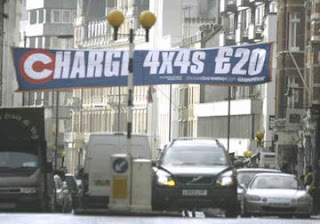
In 2005 we started our campaign along with Greenpeace to charge the most polluting vehicles more (£20) to enter London's Congestion Charge. This includes most luxury 4x4s. We prepared a report to show how this new scheme could work, overcame TfL's obstacles and we handed it to the GLA.

The consultation period period ended late last year, and while there has been some backtracking on offering incentives for people to actually switch from a large gas guzzler to a smaller and leaner vehicle, we're hopeful that there will still be a stiff charge for the most polluting cars.

As we're not against freedom of choice, it seems only fair that if someone chooses to drive a heavier and more polluting vehicle than the average citizen, then they should also be willing to accept responsibility for their choice has on the environment.

All the extra revenue from this scheme goes towards enabling better public transport