Showing posts with label 4x4s. Show all posts

Friday, March 13, 2009

Scottish vote in higher parking charges for most polluting cars in Edinburgh

Recently, local residents responded by more than three to one in favour of an initiative designed to encourage the use of more climate friendly vehicles and discourage gas guzzlers.

After several years of effort, We Are Futureproof has helped to push through CO2-based parking charges in Scotland's capital. Permit holders with the most polluting vehicles will see their charges double from the current £160 a year to £320. Drivers of the least polluting vehicles will see their permit prices fall from £80 to just £15.

Despite predictable howls of outrage from the local press, and sour grapes from the Tories, Edinburgh's Lib Dem-SNP led Council will push ahead with these charges, having secured the resounding support of 73% of the public in its 'Park Green' consultation.

Green Councillor Steve Burgess, who joined us for our Edinburgh launch in November 2006, initially proposed the scheme. He said: "I am delighted with the public response to this consultation. This is not about fat-cat charges, it is a charge aimed at reducing pollution levels."

This will be the first CO2-based parking charges scheme in Scotland. Let's hope that other places will now follow Edinburgh's lead.

You can read more here.

Gregory Norminton, for We Are Futureproof in Edinburgh

Wednesday, January 07, 2009

New video - Sindy - the 4x4 climate criminal

View our new video of Sindy - A Climate Criminal.

Many people will remember the UK version of the Barbie Doll. In this video, Sindy drives a pink Land Rover. Watch to see how she responds when she is confronted with facts about her 4x4.

Blake, for the Alliance

Friday, October 03, 2008

SUVs Targeted


Everyone knows that most males seen driving around in large blacked out luxury4x4s have one thing on their minds.

Insecurity.

We were sent this photo from an anti-SUV guerrilla action in Brussels.
The text reads: A penis enlargement would be more climate-friendly than this show off car.

Saturday, September 27, 2008

MEPs Reject Automakers Demands For Watered Down CO2 Targets

In a stunning turn of events last Thursday, MEPs in the European Parliament today voted to make carmakers play a much greater role in tackling climate change and rejected car industry attempts to weaken proposed legislation on the fuel efficiency of new cars.

With an overwhelming majority, the Parliament's Environment Committee endorsed the European Commission's proposal to cut average emissions from new cars to no more than 130g grammes of carbon dioxide per kilometre (gCO2/km) by 2012. Proposals to postpone the deadline to 2015 and to lower proposed penalties to be paid by car manufacturers were rejected. The Committee also said that average emissions in 2020 should be no more than 95g C02/km, subject to a review in 2014.

This is great news. The Committee has listened to the views of concerned citizens across Europe who overwhelmingly want tough action to make new cars more fuel-efficient and cut emissions. The low penalties and long deadlines the car industry wanted have been effectively trashed. Instead a new and overdue target of 95g Co2/km by 2020 has been agreed.

According to the Guardian, the CO2 emissions of cars make up about 14% of such emissions in Europe. The commission proposals are a key part of the overall climate-change package to cut greenhouse gas emissions by 20% by 2020 - proposals that need to be turned into law by the end of the year if the EU is to maintain its credibility as a world leader in the fight against global warming. The overall package has to be agreed by the commission, the parliament and the 27 EU governments, meaning there is now likely to be a showdown between Berlin and the parliament before Christmas.

The car industry must now focus its efforts on driving down emissions rather than self-interested lobbying.

Monday, September 22, 2008

Baby Dies as 4x4 Mounts Pavement

In a startling (yet unfortunately not uncommon) news story this week, a toddler in a pushchair was killed by a yummy mummy driving a 4x4 on the school run when she mounted the curb outside the school gates.

According to the article, "Fifteen-month-old Finlay Woods was out with his mother and grandmother when the black Toyota 4x4 crashed into his buggy, outside Selwyn junior and infant school in Chingford, north-east London, while parents gathered their children from school."

Parents tried in vain to lift the vehicle off the child, while others shielded school pupils from the distressing scene.

Witness Lee Rivers said: "I was one of about 15 people who tried to lift the car up to get the pushchair out from under it. But it was too heavy because it was a big 4x4."

Flowers were laid outside the school yesterday next to a smashed pillar and railings mangled in the crash. The mother was charged with causing death by dangerous driving, and driving while under the influence of drink or drugs.

Wednesday, September 17, 2008

Tax 4x4s More, says Lib Dems

The Liberal Democrats have called for higher taxes on large 4x4s in order to help provide fiscal incentives for people purchasing smaller efficient cars.

According to Norman Baker, buyers would get £1,000 from the government when they drove new Band A cars — which include the VW Polo BlueMotion, the Seat Ibiza EcoMotion and electric vehicles which emit 100g per CO2/km or less.

Buying one of the Band B cars would come with a £500 feebate cheque and a lower annual VED tax of about £40 to £60. Band B cars include some types of Mini Cooper, the Citroën C1 and Fiat 500 diesel — all having a CO2/km of 101g to 120g.

The incentives to go green would be covered by higher tax levies on the highest polluting cars. A showroom tax of £500, alongside £2,000 a year VED, would be imposed on gas guzzlers in the new Band M such as some Range Rover and Toyota Land Cruiser models with emissions of over 255g per CO2/km.

Friday, September 05, 2008

Jaguar and Land Rover Sales Down as Buyers Seek Efficient Cars

This news comes from ETA:

Fewer cars were sold in the month of August than at any time since 1966. The drop in sales has been especially hard on British-made luxury brands such as Aston Martin, Jaguar and Land Rover.

This time of year has traditionally been a strong time for new car sales because new registration plates were issued, but despite the fact the plates are now released in March and September and there is no longer a guaranteed peak in August, this year’s figures are particularly bad; overall sales are down 18.7 per cent on 2007.

Toyota and Land Rover have announced production cutbacks because of falls in orders and Britain’s automotive industry, which employs 815,000, is urging the government to drop interest rates to stimulate the market.

A spokesperson for the Environmental transport Association (ETA) said: “In the current economic conditions it’s quite understandable that people are unwilling to buy new cars, but it is the heavier, thirstier cars that are suffering particularly badly – smaller, greener, more frugal models are continuing to sell.”

The revised rates of emissions-based vehicle excise duty (road tax) has further harmed sales of larger, fuel inefficient cars.

To find the greenest cars, try the ETA's Car Buyers Guide

Monday, August 25, 2008

Car Makers Cancelling New 4x4 Models

In the wake of the economic downturn, consumer demand for new cars is falling. As a consequence, car makers across the USA and Europe are canceling or postponing plans to introduce new car models, including 4x4s.

According to Automotive News Europe, Renault, Opel and BMW are among car companies stopping or delaying planned new models due to difficult economic conditions. Most notably, BMW has axed its planned X7 premium 4x4. The model was to be aimed at rivals such as the Land Rover Range Rover.

Besides saving on product development, some European carmakers are also cutting production and revising down their unit sales and profit forecasts for 2008.

Here is a summary of new models being axed or delayed:
* Renault Espace, Megane crossover, Vel Satis replacements
* Opel/Vauxhall flagship, small SUV
* BMW X7
* Volvo C30 variants

Monday, August 18, 2008

Chelsea Tractors Worth More as Scrap Metal

Rising fuel prices are helping to secure the fate of 4x4s as a hugely undesirable car for the future.

A recent article in the Daily Mail reported that car dealers are refusing to take gas-guzzling 4x4s as a trade in towards new car purchases as the values for secondhand cars fall.

According to the article, 'There is no appetite at present for thirsty 4x4s that would typically cost £100 or more to fill up with petrol as fuel prices continue to soar, and become liable for more than £450 a year in vehicle excise duty by 2010 for models currently two years old.'

As the chart above shows, second-hand prices are expected to fall by 12% by Christmas.

'The one bright spark was with 'green' or alternatively-fueled vehicles, where sales rose 19.4 per cent last month.'

Sunday, August 03, 2008

Swiss Young Greens to Ban 4x4s from Switzerland

Today we received welcome news from our friends in the Swiss Young Greens, who are gaining support for a federal popular initiative to ban large heavy and polluting luxury 4x4s from the Swiss market.

In Swiss law, Swiss citizens can freely form an association and propose a modification to the Swiss Federal Constitution. The association collects signatures of Swiss citizens who support the proposal. If the Initiative collects 100,000 valid signatures the proposal is voted by the whole population of Switzerland. If accepted by the People, the Government must enforce the legislative change.

According to Vincent Rossi, about 150,000 signatures have been collected so far. The vote could occur in 2010.

With this large success, the Young Greens have surprised the Swiss political scene and reactivate the debate on consumers' 'freedom to pollute'.

Technically, the Initiative requires all vehicles that are too dangerous or too polluting to be banned from sale in Switzerland. Existing vehicles can still be used, but with limited speed. "Too dangerous" means too heavy or with a too high a front end. "Too much polluting" means emitting too much CO2 or fine particles. Swiss and international studies demonstrate the relevance of these criteria.

The Young Greens have set thresholds for private cars in order to especially target SUVs and powerful roadsters: 250 gCO2/km and 2.5 mg PM10/km. Half of the SUVs sold in Switzerland would be hit, while only 6% of the family cars would. A 'light or ecological' car emits about 100 gCO2/km. A large SUV can reach 400 gCO2/km.

Thursday, June 19, 2008

Alliance Wins Legal Challenge: Car Billboard Ads to Show Climate Impact

Car adverts on billboards and in magazines will now be emblazoned with the car’s climate impacts, after the Government yesterday agreed to change its advertising guidelines in response to the threat of legal proceedings by the Alliance Against Urban 4x4s.

The fuel consumption and CO2 emissions of vehicle will now have to be prominently displayed, arming consumers with the information they need to choose a greener vehicle – and one that needs to be filled up with fuel less often.

The Department for Transport admitted that it had been wrongly interpreting an EU Directive on car advertising, which says that fuel economy and carbon dioxide emissions information must be prominently provided in all promotional literature. The Government has until now exempted ‘primarily graphical’ adverts from the law with the effect that most billboard adverts did not include information about the car’s carbon dioxide emissions.

The announcement came in response to a legal letter to the Department for Transport from Friends of the Earth’s Rights & Justice Centre acting for the Alliance Against Urban 4x4s. We wrote to the DfT in March to point out that the UK wasn’t abiding with EU law and warned the Government that they would issue Judicial Review proceedings if the guidance was not changed.

From now on, it won’t be enough to woo consumers with a sleek and sexy image of a car in billboard ads – car advertisers will need to give real and readable facts about the car’s fuel economy and environmental impact. With rising fuel costs and a growing awareness about climate change, this information is crucially important for people to make greener and cheaper choices of vehicle.

In order to cut emissions from cars, we need both strong regulation on advertising and also strong regulation that forces car manufacturers to make more efficient cars. Today’s change in the advertising rules will help encourage car-makers to build more efficient vehicles, something they have so far been very slow to do.

Phil Michaels, Head of Legal at Friends of the Earth said:
“Until now allowed the UK was getting away with flouting EU legislation on car advertising – but our legal action has closed the loophole.

“Consumers have a right to meaningful information about how much carbon dioxide a car emits and how much fuel it guzzles, so they can choose to buy a car that will be greener and cheaper to run. We will be watching carefully to make sure that the law is now properly enforced.”

See the cars and CO2 campaign website here: http://www.advertiseCO2.co.uk

Sunday, June 08, 2008

New Health Warnings on Car Ads


Lib Dem MEP Chris Davies and the EU Environmental Committee have started a move that may see 20% of all car ads covered with health warnings similar to the one pictured.

According to Mr. Davies, "I want to encourage a shift in consumer behaviour which will communicate to car manufacturers in a financial way that it's in their interests to reduce emissions. Manufacturers of high emission cars hate this idea."

Londoners can attest to the anger of car manufacturers when they hate an idea; Porsche recently ran an all out PR battle to have Ken Livingstone defeated when he threatened to charge their beloved gas guzzlers up to £25 per day.

Promotional material including magazines, newspapers and billboards posters for new cars must currently include CO2 and fuel consumption information, although many car manufacturers fail to comply. The European Commission is now being urged not only to enforce the existing regulations but also to extend the rules to cover television, radio and internet.

Monday, May 19, 2008

Manufacturers' Claims on CO2 Emissions Inaccurate

We came across two interesting articles in the national press. Lewis Smith argues in The Times that the emissions data that consumers rely on to make more environmentally sound choices is usually completely inaccurate. Car companies are accused of jumping on the “eco” bandwagon to make their brand seem greener, even though the figures don’t back them up.

The article refers to independent testing by Auto Express magazine. When they tested the CO2 emissions for some 'relatively green' cars, such as the Polo Blue Motion, they found a discrepancy between figures supplied by the car makers and theirs done in real world conditions.

We feel that the article doesn’t mention the comparative point – if a Honda Civic is “advertised” to put out 109g/km of CO2 and “actually” puts out 171, then where does that leave our friend the Porsche Cayenne? Using the same maths, its claimed output of 358g/km becomes a sky-high 562. Just because so-called “green” cars are getting a bad press doesn’t suddenly make hugely inefficient gas guzzling cars less of a problem. In fact, we should all be worried.

The article reinforces the fact that most emissions and efficiency data is calculated by the manufacturers themselves, usually in completely abnormal conditions, so is both biased and effectively useless. What’s needed is a truly independent method of testing new cars, as trustworthy from the consumer’s point of view as the Euro NCAP safety ratings.

Labeling of CO2 emissions also comes into Peter Popham’s article in The Independent. He notes that the Europe-wide breaches of the 1999 EU Directive on car advertising have resulted in the EU preparing to introduce tougher new rules regarding the display of emissions data. He even suggests that cars will soon go the way of cigarettes and alcohol, and making them look “desirable” may be frowned upon.

This is an area the Alliance has been pushing on recently, through the AdvertiseCO2 website, and it looks like we can expect more details about what happens next at the start of June.

Thursday, May 15, 2008

Our Friend Miranda

We don't always want to talk about boring politics and what manufacturers and the government isn't doing - so we thought we'd mention our friend Miranda, over at the Accidental EcoManiac

Introducing her blog she writes: "I never wanted to become an EcoManiac. I was busy living the good life, complete with retail therapy and long-haul flights. In fact, when I moved back to London in 1999, I thought our home would be just perfect if we added a patio heater and outdoor hot tub. Who knew I was an accomplice in the murder of the planet?"

She writes lots of great articles and provides links to new 'green' stuff, including 'hot wheels'.

Miranda's written us this Top Hole entry all about 4x4s: "The 4x4 phenomenon (in the US and now in the UK and worldwide) is a triumph of advertising and cultural persuasion over common sense. For a while, MPG was the buzzword and it seemed cars were getting smaller and more efficient (and cheaper). Of course that’s not great news for car manufacturers – or the oil companies – so they started supersizing cars (and their advertising budgets)."


"I remember the first time I heard someone describe a 4x4 as 'sexy' (maybe 1981, soon after Reagan was elected, but when the ‘oil crisis’ of the 70s was still fresh in the mind.) I was shocked - at that time small sport scars were the height of cool (and midlife crises). I suppose 4x4s hint of a sporty, outdoorsy lifestyle (though instead of surfboards or camping gear, most 4x4s carry nothing more thrilling than the weekly shop)."


"Throughout the 90s and 00s, cars plumped up. At first they looked a bit OTT, but as the years passed and more people bought them, the behemoths didn’t look quite so odd. And celebrities' star power rubbed off and helped make 4x4s 'cool'. The ‘safety’ argument helped salve any misgivings and made people feel proud of their choice – and happy to defend it. Of course 4x4 are not so great for other road users or us pedestrians, but hey, there aren’t that many pedestrians in America anyway."


"Big cars got another boost when the IRS tax system (US) had a loophole for some SUVs allowing a deduction of up to $25,000 for for vehicles between 6-14,000 pounds. Buy a bigger car and get a 'rebate'? Who could resist that? Not many: most people in the US - even teenagers - drive gigantic cars. But now many families are finding it too expensive to fill up their 'gas guzzler' in order to travel to work, school or the shops, and the 4x4 craze doesn't seem quite so clever."


"Unfortunately the UK public has also indulged in bigger and heavier cars. The advertising seems irresistible. A 4x4 glides through the Nevada desert on an empty highway. Another climbs a cliff - what a thrilling adventure! What if ads had to show the grim reality – a frustrated UK driver trying to manoeuvre a 4x4 on a narrow road in an English village (or even in London), or trying to squeeze its giant girth into a standard car park space."


"I just can’t see why many people need a car like this (especially not in London). If your self-esteem needs a boost, do some volunteering or try to become a better person. Driving a big car doesn’t make you a big man (or woman)."


Cheers, Miranda

Thursday, May 08, 2008

The End of Cheap Oil

Today I received an email about how to protest the rising price of oil in the UK. In case you haven't noticed (or just don't drive), the recent price of petrol is up to near £1.30 per litre

I read the email suggesting that motorists boycott Esso and BP garages and realised that the sender didn't really get it, as probably most drivers don't.. the era of cheap oil is over.

Now, we do sympathetically agree that the Big Oil companies are making ludicrous profits. However, the rising cost of oil is a good thing, as it will force us to transition to a non-carbon society.

It's not rocket science: oil is becoming more expensive because consumer demand is outstripping the available supply. And the oil that is left in the ground is harder, more expensive, and more polluting to extract.

Monday, April 21, 2008

Richmond: School Run Charges for Hi-CO2 Cars

In another ground breaking move by Richmond Council, cars on the school run are to pay for temporary council parking permits which will vary in price according to the CO2 emissions level of the car. The pilot is scheduled to start in September.

According to the Telegraph article, 'Parents are to be charged up to £75 a year by councils to drop their children off on the school run.'

'Richmond introduced "environmentally friendly" parking charges based on vehicle emissions in late 2006 and now the Liberal Democrat authority has gone further by introducing its "permits for school parents", affecting hundreds of people across 13 schools in the borough.

'Previously, parents could collect a free permit from the school, allowing them to park on yellow lines or in nearby bays for 10 minutes. From September, they will have to get a council permit to park in bays near the school for 15 minutes.'

'The fee will vary according to the car's carbon dioxide emissions, with owners of small cars paying nothing, while most parents with people carriers or four-wheel-drives, pay the full £75.'


Friday, April 18, 2008

Neither Porsche Nor Boris Can Drive Away from Global Warming


Reprinted from an article in the New Statesman by Tony Bosworth at Friends of the Earth:

"The mayoral candidates need to consider global warming when discussing the congestion and emission charges.

Car ads sell us a particularly seductive modern day fantasy. We are promised open roads cutting through sweeping panoramic landscapes, speed, freedom, and excitement.

But for those of us who find ourselves inching along in snarled up traffic, the lack of speed isn’t the only difference between the dream and the reality of modern day motoring. Road transport accounts for about a fifth of the UK’s carbon emissions – and research shows using greener cars could be the fastest way to slash this. Therefore moves by national and local government to encourage drivers to use smarter cars – such as the Mayor of London’s proposal to increase the congestion charge to £25 for gas-guzzlers - are welcome.

Ken Livingstone’s proposal has infuriated Porsche, which has launched a legal challenge against what it brands a ‘disproportionate’ measure. Of the 53 types of car that Porsche sells in the UK, 51 would pay the higher charge. In a document seen by the Daily Telegraph, the car manufacturer estimates its sales would fall by 11 per cent if the higher charge came in.

The London congestion charge isn’t the only climate-changing initiative that Porsche opposes. Along with the rest of the car industry, Porsche - which boasts of “protecting the environment to the highest degree” - is fighting new targets to reduce pollution from new vehicles by increasing their fuel efficiency. Could the bottom line be concentrating their minds?

Of course, if Ken doesn’t get elected as Mayor of London on 1 May then Porsche’s London legal challenge will vanish into thin air. Both Boris Johnson and Brian Paddick would drop the proposed gas-guzzler charge.

It’s telling, though, that neither of them would abolish the congestion charge in the original central London zone, pledging only to reopen consultation on the more recent extension into west London. Boris’s promise to look at introducing a flexible pricing system to target the worst congestion seems sensible – until you consider that many of the capital’s top congestion hot-spots are actually in outer London.

Brian Paddick’s plan to introduce a London-wide charge for all cars entering London from outside the city are certainly ambitious, but it would need top notch monitoring technology and drastic negotiations with train and bus operators to ensure the infrastructure is in place to shuttle a high volume of incomers into the capital and out again.

The Lib Dem and Tory candidates have also pledged to re-phase traffic lights to get traffic moving faster – a move which neither takes account of those of us trying to cross the road on foot nor tackles the central problem of the sheer volume of traffic on London’s roads.

The congestion charge is not perfect, but it’s a vital tool that, now it is in place, can be fine tuned and perfected in time. And it is crucial in sending the message to the rest of the world that global warming is not something any of us can simply drive away from in a cloud of dust."


Wednesday, April 09, 2008

Dinosaur Hunt Leads Team to a Petrified Porsche

Today, campaigners from the Alliance Against Urban 4x4s led a dinosaur hunt through Berkeley Square to the Porsche dealership in Mayfair, exposing Porsche as a dinosaur company petrified by a changing climate. Unless Porsche adapts their business model they will become extinct.

Adorned in pith helmets and hiking boots, equipped with binoculars and dinosaur field guides, campaigners lead members of the public to seek out those last remaining urban dinosaurs, relics like the Porsche Cayenne Turbo, Porsche 911 GT2 and other prehistoric Porsche species. Their banner read: Petrified Porsche – Stop Being a Dinosaur: Adapt or Become Extinct, while placards asked passers by to spot the difference between an Anchiceratops and a Porschus Carbonosaurus.

Porsche forced themselves into the limelight in the UK by legally challenging the latest congestion charge plans. According to their legal papers they will be representing all band G car owners. However, preserving sales are blatantly Porsche's main, perhaps only concern. 44 of the 45 cars they produce are in Band G, and when the £25 congestion charge is introduced in October, Porsche expect sales to plummet by 11%.
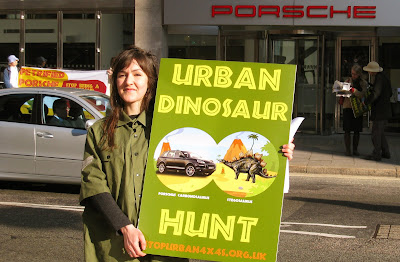
Londoners aren't the only one's to feel the brunt of Porsche's position as a carbon dinosaur.

Porsche are also fighting any attempts towards meaningful and binding emissions reductions by seriously undermining the EU CO2 regulations. According to Citigroup Global Markets, "Porsche faces huge financial penalties if the EU's demands are not watered down. Porsche would need to improve its fleet average fuel consumption from 20 mpg to close to 40 mpg by 2012, to avoid fines of more than $736 million by 2016". To do this they would have to cut an eye watering average of 138gm/km CO2 per car in order to meet the current target of 120 gm/kmCO2 by 2012.

To amplify how ill prepared Porsche is for change, Herbert Ampfere, Porsche's manager for energy and environment, said that the new EU rules on CO2 could lead to the company's demise.

The Porsche Cayenne Turbo is one of the most polluting 4x4s on the market, emitting an extraordinary 358g of CO2 per kilometer. Its peculiar design is a prehistoric spectacle of both enormous power and weight. A Porsche Cayenne Turbo can travel up to 171 miles per hour, but in London you're more likely to be crawling along at 5 miles per hour in traffic rather than burning the tarmac like Porsche's ads might suggest.

Recently the Telegraph wrote "that 2008 is likely to go down as the year when even the most die-hard petrol-head realised that there will be no U-turn in the drive to abolish gas-guzzlers and develop more fuel-efficient cars. In the UK, Porsche's legal battle with London Mayor Ken Livingstone and the Chancellor's Budget measures to penalise thirsty cars may come to be seen as tipping points in officialdom's crackdown on the biggest emitters of C02. It's a situation being replicated around the world."

We expect to see a public backlash, and Porsche will suffer even more in its PR faux pas. Londoners feel that they, not Porsche, should decide whether or not to proceed with the CO2 charge on gas guzzling vehicles. To illustrate this point, some of the signatories on our petition against the Porsche legal challenge have included hefty comments such as the one below:

Mr. Robinson from NW11 writes: "I am disgusted by Porsche's attempts to prevent the imposition of a congestion charge on polluting cars in London. Porsche's stance looks both irresponsible and arrogant. And it is appalling PR. Even if the company choose not to support the ban by being so vocal in opposition they ally themselves with the past and not the future…Porsche are ensuring that they are seen to be irresponsible."

We feel that more actions are needed to challenge fossilized manufacturers, like Porsche, who are either oblivious like dodos or showing their teeth like velociraptors rather than clean up their vehicle fleets. Their engineering teams are perfectly able to make cars that don't create the excessive amounts of emissions of band G cars, yet that is where most have traditionally profited. With this new C Charge helping to change people's buying habits, the pressure is now on manufacturers like Porsche to produce and advertise cleaner cars for their customers.

With today's action we have focused the attention on a real dinosaur. We know Londoners will be watching to see if or how well Porsche can respond to the pressures for change.

Facts about Porsche

• Last year, Porsche also challenged the EU Commission as they drew up plans to set tough CO2 targets for the car industry. Porsche, who would be most affected by the new EU regulations, would need to cut an eye watering average of 138gm/km CO2 per car in order to meet the current target of 120 gm/kmCO2 by 2012.

• Porsche, as a member of ACEA have also lobbied for delays and weakening of years of European pollutant emissions standards for cars (Euro standards).

• In the USA, Porsche exerted their influence to weaken new CAFE standards in summer 2007. Porsche arranged for a Senator to offer an exemption ('application of an alternative average fuel economy standard') for small auto companies, and argued that as a low volume manufacturer, they couldn't meet 35 miles per gallon, requiring a weaker standard. The move was defeated.

• Porsche only produce gas guzzling and high-carbon emitting sports cars and SUV's. 44 out of 45 Porsche vehicles fall in Band G, the other in band F. The Cayenne Turbo is one of the most polluting 4x4s, with 378gCO2/km - that's nearly four times the level of the low emission VW Polo Blue Motion.

• The plain truth is - Porsche are at the top of the European league table as the most polluting
carmaker.

Tuesday, April 01, 2008

Porsche Makes a Public Apology to Londoners!

Today, in a breathtaking turnaround, the German sports car maker Porsche made a startling public apology to Londoners, and Mayor Ken Livingstone's Office!

According to Managing Director Andy Goss, Porsche apologized:

“For being so pigheaded in pushing for a judicial review of the recent changes in the congestion charge. A bit rash we know! Sorry. But now that we think about it, the change does actually seem quite a good idea.”

He continued, “And ok, you’ve got us. With a few of our mates, we have been doing our best to railroad EU plans to set binding emissions targets for gas guzzlers by 2012. Can’t blame us for having a go though can you? Ok, so you can. But look, we know it’s wrong”.

Finally, he added, “Oh, and last, but by no means least, we should stop claiming we’re ‘green’ while making incredibly polluting cars. So we’re pleased to announce a new concept model, taking the 4x4 into the 2x2 age.”

Wow. We're still a bit caught off guard here at the Alliance, but this goes to show that miracles do happen, even in the 21st century.

If anyone wants to thank Porsche directly for their tremendously courageous turnaround, they can be contacted by email at customer.assistance@porsche.co.uk or by telephone: +44 8457 911 911